The Collecting Adventure

The Pleasure of Collecting.

African Ethnic Stamps and Postcards

A Ethnic view of Africa. The Richness and Beauty of African Culture and People.

Germany - History On Stamps

100 years of German History told in Stamps, Letters and Postcards.

French Stamps

The Culture and the History of France in Stamps.

The Virtual Art Museum

The Art in Stamps. Painting, Sculpture and Art Personalities in a Virtual Philatelic Museum.

Jul 22, 2012

Germany on Stamps: Frederick, The Great

KING FREDERICK, THE GREAT

(24 January 1712 - 17 August 1786)


Frederick II was a King in Prussia (1740–1786) from the Hohenzollern dynasty. In his role as a prince-elector of the Holy Roman Empire, he was Frederick IV (Friedrich IV) of Brandenburg. He was in personal union the sovereign prince of the Principality of Neuchâtel and became known as "Frederick the Great" (Friedrich der Große) and was nicknamed "der alte Fritz" (Old Fritz).

Frederick was born in Berlin, the son of King Frederick William I of Prussia and Sophia Dorothea of Hanover. The so-called Soldier-King, Frederick William had developed a formidable army and encouraged centralization, but was also known for his authoritarianism and temper. In contrast, Sophia was well-mannered and well-educated. Her father, George, Elector of Hanover, was the heir of Queen Anne of Great Britain.

Interested primarily in music and philosophy and not the arts of war during his youth, Frederick unsuccessfully attempted to flee from his authoritarian father, Frederick William I, with childhood friend, Hans Hermann von Katte, whose execution he was forced to watch after they had been captured.

Frederick served at Prussian Army as Colonel of the Regiment von der Goltz, stationed near Nauen and Neuruppin. When Prussia provided a contingent of troops to aid Austria during the War of the Polish Succession, Frederick served under Prince Eugene of Savoy, during the campaign against France, on the Rhine.

In 1739, Frederick finished his "Anti-Machiavel", an idealistic refutation of Machiavelli. It was published anonymously in 1740, but Voltaire distributed it in Amsterdam to great popularity. Frederick's years dedicated to the arts instead of politics ended upon the 1740 death of Frederick William and his inheritance of the Kingdom of Prussia.

When Frederick ascended the throne as "King in Prussia" in 1740, Prussia consisted of scattered territories, including Cleves, Mark, and Ravensberg in the west of the Holy Roman Empire; Brandenburg, Hither Pomerania, and Farther Pomerania in the east of the Empire; and the former Duchy of Prussia, outside of the Empire bordering the Polish-Lithuanian Commonwealth. He was titled King in Prussia because this was only part of historic Prussia; he was to declare himself King of Prussia after acquiring most of the rest in 1772.

Frederick structured their predecessor's army. In 1740 Frederick invaded Silesia, seizing the moment in which Austria was particularly vulnerable. It was the beginning of the Austrian Succession War. Shortly after, Prussia and Austria signed a secret treaty of peace that recognized the achievements of Frederick II and allowed the Austrian army to retreat to Moravia.

The Austrian Succession War confirmed the possession of Silesia by the Prussian king. In 1744, Frederick invaded Bohemia but, was not the expected success. Exhausted, his army retreated to Silesia where he obtains three decisive victories. After those victories, Frederick established the "Treaty of Dresden", with Austria and Saxony, in 1745. In half a century, Prussia has tripled its population due to the acquisition of Silesia, by this treaty.

Victorious, would soon feel threatened by the creation of a coalition formed by Austria and Russia. Allying itself with Britain, eventually preemptively invade Saxony in 1756, beginning the Seven Year's War.

Frederick successfully resisted the combined efforts of France, Austria and Russia. During this conflict, his kingdom was attacked from all sides and Berlin was occupied twice by enemy troops.

Frederick won great victories, like the battles of Rossbach, Leuthen and Prague. He is considered one of the greatest military leaders in history.


Out with Prussia, Frederick was saved by the death of the Russian empress and the ascent to the throne of Czar Peter III, who admired him. Ended the conflict, with perseverance reorganized its states, which were weakened by the war.

Frederick managed to transform Prussia from a European backwater to an economically strong and politically reformed state. Frederick was able to give Prussia a modern bureaucracy and a system of education was seen as one of Europe's finest. Frederick also abolished torture and corporal punishment.

Frederick died in an armchair in his study in the palace of Sanssouci on 17 August 1786.

Germany on Stamps: Henrich Schutz

COMPOSER HEINRICH SCHÜTZ

(October 8 (Julian calendar), 1585 – November 6, 1672)


Heinrich Schütz, born in Köstritz and was a German composer and organist, generally regarded as the most important German composer before Johann Sebastian Bach and often considered to be one of the most important composers of the 17th century along with Claudio Monteverdi. He wrote what is thought to be the first German opera, Dafne, performed at Torgau in 1627, of which the music has since been lost. He is commemorated as a musician in the Calendar of Saints of the Lutheran Church on July 28 with Johann Sebastian Bach and George Frideric Handel.
Schütz Life
In 1590 Schütz family moved to Weißenfels, Germany, where his father Christoph managed the inn "Zum Ring". When Schütz lived with his parents, his musical talents were discovered by Moritz von Hessen-Kassel in 1599.

After being a choir-boy he went on to study law at Marburg before going to Venice from 1609–1612 to study music with Giovanni Gabrieli. Gabrieli is the only person Schütz ever referred to as being his teacher. He also inherited a ring from Gabrieli shortly before the latter's death. He subsequently had a short stint as organist at Kassel before moving to Dresden in 1615 to work as court composer to the Elector of Saxony.

In Dresden Schütz sowed the seeds of what is now the "Sächsische Staatskapelle Dresden" (Dresden State Orchestra), but left there on several occasions. In 1628, he went to Venice again, where he met and studied with Claudio Monteverdi.

In 1633 he was invited to Copenhagen to compose the music for wedding festivities there, eventually returning to Dresden in 1635. He again conducted an extended visit to Denmark in 1641. In 1655, the year that his daughter Euphrosyne died, he accepted an ex officio post as Kapellmeister (person in charge of music-making) at Wolfenbüttel, Germany.

Schütz died in Dresden from a stroke in 1672 at the age of 87. He was buried in the Dresden Frauenkirche but his tomb has been destroyed.
Schütz style
Schütz's compositions show the influence of his teacher Gabrieli and of Monteverdi. His best known works are in the field of sacred music, ranging from solo voice with instrumental accompaniment to a cappella choral music, which is the vocal music without instrumental accompaniment.

Practical considerations were certainly responsible for part of this change: the Thirty Years' War had devastated the musical infrastructure of Germany, and it was no longer practical or even possible to put on the gigantic works in the Venetian style which marked his earlier period.

Schütz was one of the last composers to write in a modal style. His harmonies often result from the contrapuntal alignment of voices rather than from any sense of "harmonic motion". Much of his music shows a strong tonal pull when approaching cadences.

Almost no secular music by Schütz has survived, save for a few domestic songs and no purely instrumental music at all, even though he had a reputation as one of the finest organists in Germany.

Schütz was of great importance in bringing new musical ideas to Germany from Italy, and as such had a large influence on the German music which was to follow. The style of the north German organ school derives largely from Schütz.
Schütz major's works
There are over 500 total surviving individual pieces by Schütz.

Most of these contain multiple pieces of music; single published works are listed in the complete work list, as are major unpublished works such as the Seven Last Words, and the Passions according Matthew, Luke and John.

The following are major published works:
  • Il primo libro de madrigali (first book of madrigals) (opus 1, Venice, 1611)
  • Psalmen Davids (Book 1) (opus 2, Dresden, 1619
  • Historia der... Aufferstehung... (The Resurrection) (opus 3, Dresden, 1623)
  • Cantiones sacrae (opus 4, Freiburg im Breisgau, 1625)
  • Becker Psalter (opus 5, Freiburg im Breisgau, 1628, revised 1661)
  • Symphoniae sacrae (Book 1) (opus 6, Venice, 1629)
  • Musikalische Exequien (opus 7, Dresden, 1636)
  • Kleine geistliche Konzerte (Book 1) (opus 8, Leipzig, 1636)
  • Kleine geistliche Konzerte (Book 2) (opus 9, Leipzig, 1639)
  • Symphoniae sacrae (Book 2) (opus 10, Dresden, 1647)
  • Geistliche Chor-Music (opus 11, Dresden, 1648)
  • Symphoniae sacrae (Book 3) (opus 12, Dresden, 1650)
  • Zwölf geistliche Gesänge (opus 13, Dresden, 1657)
  • Historia, der... Geburt... Jesu Christi (The Nativity), (Dresden, 1664)
  • Königs und Propheten 119er Psalm... (Psalm 119, Psalm 100, and German Magnificat: "Swan Song") ("opus ultimum" (the last work), Dresden, 1671)

Jul 11, 2012

Germany on Stamps: Nuremberg Castle


NUREMBERG CASTLE


Nuremberg Castle is a historical building on a sandstone rock in the north of the historical city of Nuremberg, Bavaria, Germany. It comprises three sections: the imperial castle ("Kaiserburg"), some buildings of the Bur graves of Nuremberg ("Burggrafenburg"), and the municipal buildings of the Imperial City at the eastern site ("Reichsstädtische Bauten").

After the damage in the Second World War the castle was rebuilt in historical forms. It counts in its historical character as a defensive structure and residence of the emperors, imperial castle Hohenzollern Burggraf and to the historically and architecturally based major military installations in Europe. Related to Nuremberg is regarded as one of the most important art and architectural monuments of the city and belongs to the Historical Mile Nuremberg.
Brief History
Archaeological investigations during recent days indicate that the place was already settled around the year 1000, although this has not been backed up by any documentary proof. Nuremberg was first recorded in 1050, when Henry III visited the town, but there is no specific mention of the castle. The castle does not appear in any documents until 1105.

In 1140, King Conrad III started building a second castle on the site, to be used as a royal residence.

In the 13th century, Nuremberg became an Imperial Free City, and the castle fell into the care of the city. Of all the parts of the castle built during this time, the Luginsland Tower ("watch-over-the-land" Tower), begun in 1377, stands out.

Legend has it that in 1381, the robber baron Eppelein von Gailingen escaped death on the gallows when his horse leapt into the castle moat. It is said that at this certain place the imprints of his horse's hoofs are still visible in the fortification wall.

In the second quarter of the 19th century, measures were taken to preserve the buildings.

After the Nazis seized power in 1933 the conversion began in the Imperial Castle. The Imperial Castle served as part of the annual party rallies. It was the symbolic backdrop for the Nazi regime as well as accommodation for high state visitors.

In World War II, the castle was damaged in 1944-45, with only the Roman double chapel and the Sinwell Tower remaining entirely intact. After the war, the castle was restored to its historical form, including the Luginsland tower which had been completely destroyed. The additions of the 19th century have been partly removed in 1934-35.

Today, the eastern municipal buildings of the castle, "Kaiserstallung" and "Luginsland", are used as a youth hostel.

Germany on Stamps: Composer Georg Händel

GEORG FRIEDRICH HÄNDEL


(23 February 1685 – 14 April 1759)


Georg Friedrich Händel born in Halle in the Duchy of Magdeburg (province of Brandenburg-Prussia) was a German-British Baroque composer, famous for his operas, oratorios, anthems and organ concertos.

He received critical musical training in Halle, Hamburg and Italy before settling in London (1712) and becoming a naturalized British subject in 1727. By then he was strongly influenced by the great composers of the Italian Baroque and the middle-German polyphonic choral tradition.

Händel displayed considerable musical talent at an early age. Nevertheless, the young Händel was permitted to take lessons in musical composition and keyboard technique from Friedrich Wilhelm Zachow, the organist of the Liebfrauenkirche, Halle.

In 1702, Händel began the study of law at the University of Halle, but after his father's death the following year, he abandoned law for music, becoming the organist at the Protestant Cathedral.

Within fifteen years, Händel, a dramatic genius, started three commercial opera companies to supply the English nobility with Italian opera, but the public came to hear the vocal bravura of the soloists rather than the music.

In 1723 G.F. Handel moved into a newly built house at Brook Street, London, in England, which he rented until his death in 1759.

In 1727 G.F. Händel was commissioned to write four anthems for the coronation ceremony of King George II. One of these, "Zadok the Priest", has been played at every British coronation ceremony since.

Händel was director of the Royal Academy of Music from 1720 to 1728 and a partner of J.J. Heidegger in the management of the King's Theatre from 1729 to 1734. Händel also had a long association with the Royal Opera House at Covent Garden, in London, England, where many of his Italian operas were premiered.

With a physical breakdown, he changed direction creatively and addressed the middle class. As "Alexander's Feast", in 1736, was well received, Händel made a transition to English choral works.

In April 1737, at age 52, he suffered a stroke or some other malady which left his right arm temporarily paralysed and stopped him from performing. He also complained of difficulties in focusing his sight.

After his success with "Messiah", in 1742, he never performed an Italian opera again. Händel was only partly successful with his performances of English Oratorio on mythical or biblical themes, but when he arranged a performance of "Messiah" to benefit the Foundling Hospital, in 1750, the critique ended.

The pathos of Händel's oratorio is an ethical one; they are hallowed not by liturgical dignity but by the moral ideals of humanity. Almost blind, and having lived in England for almost fifty years, he died a respected and rich man.
Händel's compositions
Händel's compositions includes 42 operas, 29 oratorios, more than 120 cantatas, trios and duets, numerous arias, chamber music, a large number of ecumenical pieces, odes and serenatas, and 16 organ concerti.

His oratorio "Messiah", with its "Hallelujah" chorus, is among the most famous works of classical music and is a popular choice for performances in the Christmas season.

Among Händel's best-known instrumental works are the Concerti Grossi Opus 3 and 6; "The Cuckoo and the Nightingale", in which birds are heard calling during passages played in different keys representing the vocal ranges of two birds; and his 16 keyboard suites, especially "The Harmonious Blacksmith".

Collected editions of Händel's works include the Händel-Gesellschaft (HG) and the Hallische Händel-Ausgabe (HHA); however, the more recent Händel-Werke-Verzeichnis (HWV) publication is now commonly used to number his works. For example, Händel's Messiah can be referred to as: HG xlv, HHA i/17, or HWV 56. Some of Händel's music is also numbered based on initial publications, for example a 1741 publication by Walsh labeled twelve of Händel's concerti grossi as "Opus 6".

Jul 5, 2012

Stamps of France: New 1942 Set


New Complete Set from Vichy France (1942).

Nova Série Completa da república de Vichy (1942).

Stamps of France: Legion Tricolor


THE LEGION TRICOLOR


The "Légion Tricolore" (Legion Tricolor), was created in 1941, existed only on paper and was abandoned in the fall of 1942.

The Legion Tricolor is an attempt by the Vichy government (Laval and his Secretary of State Jacques Benoist-Méchin) to recover politically and militarily the LVF (Legion of French Volunteers). The LVF was the creation of the French collaborationist parties and had a status of private association.

The LVF fought in German uniforms (Feldgrau) in a regiment of German infantry on the Eastern Front, which had made it almost impossible to recruit a great numer of volunteers. They hated to fight under a foreign uniform.

The LVF is torn by the collaborationist political parties struggling to impose itself on his head. Management of the legion is deplorable, many embezzlement, and a sprawling bureaucracy reigns true in Paris while the troops are being slaughtered on the forehead.

The Legion Tricolor was intended to snatch the LVF its political strife, to create a French force with French targets (intervention in North Africa in particular), to recruit military armistice army and increase collaboration with the Germans.

A delegate from the Armistice Commission conducted an investigation that led the Germans to demand the French government the dissolution of the Legion, because they did not recognize it. Hitler banned it on September 17, 1942. The French government then complied with the Decree No. 1113 of December 28, the Legion dissolution.

Jun 27, 2012

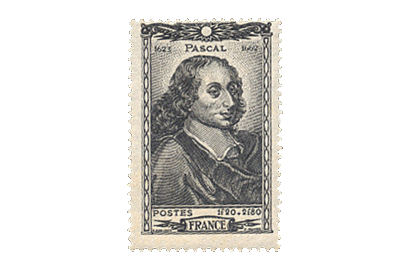
Stamps of France: Blaise Pascal


BLAISE PASCAL

(19 June 1623 – 19 August 1662)


Blaise Pascal was born in Clermont-Ferrand and died in Paris, France. He was a French mathematician, physicist, inventor, writer and Catholic philosopher.

Pascal's earliest work was the study of fluids, and clarified the concepts of pressure and vacuum by generalizing the work of Evangelista Torricelli. Pascal also wrote in defense of the scientific method.

In 1642, while still a teenager, he started some pioneering work on calculating machines. After three years of effort and 50 prototypes, he invented the mechanical calculator. He built twenty of these machines (called the Pascaline) in the following ten years.

Pascal was a mathematician of the first order. He helped create two major new areas of research. He wrote a significant treatise on the subject of projective geometry at the age of sixteen, and later corresponded with Pierre de Fermat on probability theory, strongly influencing the development of modern economics and social science. Following Galileo and Torricelli, in 1646, he refuted Aristotle's followers who insisted that nature abhors a vacuum. His results caused many disputes before being accepted.

In late 1654, he abandoned his scientific work, and devoted himself to philosophy and theology. His two most famous works date from this period: the "Lettres provincials" (Provincial letters) and the "Pensées" (Thoughts), the former set in the conflict between Jansenists and Jesuits. In this year, he also wrote an important treatise on the arithmetical triangle. Between 1658 and 1659 he wrote on the cycloid and its use in calculating the volume of solids.

Pascal had poor health especially after his eighteenth year and his death came just two months after his 39th birthday.

Jun 21, 2012

Stamps of France: 1944 Page


New Vichy France Page with stamps from 1944. The last page of this important moment of France history.

Nova página da República de Vichy com selos de 1944. A última página deste momento importante na história de França.

Stamps of France: Vichy France


FRANÇA DE VICHY


(1940 – 1944)


França de Vichy, Regime de Vichy, ou Governo de Vichy, são termos comuns usados para descrever o governo Francês que colaborou com as potências do Eixo, entre Julho de 1940 e Agosto de 1944. Este governo sucedeu a Terceira República e precedeu o Governo Provisório da República Francesa. Oficialmente chamado de Estado francês (État Français), contrastando a designação anterior, a República Francesa.

O Marechal Philippe Pétain proclamou o governo após a derrota militar da França pela Alemanha durante a Segunda Guerra Mundial e a seguir à votação da Assembleia Nacional, em 10 de Julho de 1940. Esta votação garantia extraordinários poderes a Pétain, o último "Président du Conseil" (Primeiro Ministro) da Terceira República que, de seguida, se intitulou adicionalmente "Chef de l'État Français" (Chefe do Estado Francês).

O regime de Vichy manteve alguma autoridade legal na zona norte da França (a "Zone occupée"), ocupada pela Wehrmacht Alemã. As suas leis, no entanto, só foram aplicadas nas zonas onde os Alemães não eram contestados. Isto significava que o regime era mais poderoso a sul da desocupada "zona livre", onde o centro administrativo de Vichy esteve instalado até Novembro de 1942.

Após o desembarque das forças Aliadas no norte de África a 08 de Novembro de 1942, Hitler ordenou a ocupação de zona livre Francesa, ficando sujeita à regra Alemã da zona norte, com a excepção de uma faixa ao longo dos Alpes que se manteve sob domínio do Estado Italiano até Setembro de 1943.

No rescaldo da derrota de 1940, Pétain colaborou com as forças de ocupação Alemãs em troca da não divisão da França entre os Poderes do Eixo. As forças de Vichy recusaram render-se ou salvar a frota em Mers-el-Kebir dos Aliados e lutou contra a invasão Aliada nas zonas controladas pela França, a Síria e o Líbano, entre Junho e Julho de 1941, com pouco mais de 15% dos prisioneiros resultantes da guerra a decidir participar nas forças Francesas Livres, enquanto os restantes foram repatriados para a França metropolitana para serem desmobilizados.

No entanto, os laços militares com a Alemanha enfraqueceram ao longo do tempo. O mandato de Vichy sob a frota Francesa em Toulon contrasta com o episódio de Mers-el-Kebir, nos dois anteriores anos, com a limitação à resistência das forças Francesas de Vichy à invasão Aliada do Norte de África, onde mais comandantes e unidades se juntaram às forças da França Livre. Os líderes de Vichy ordenaram à polícia Francesa e à "milice" (milícia) local para fazerem incursões a fim de capturar Judeus e outras minorias consideradas "indesejáveis" para Alemanha, bem como adversários políticos e membros da Resistência, ajudando, assim, a reforçar a política Alemã nas zonas ocupadas. Vichy também promulgou as suas próprias leis e políticas inspiradas na restritiva política Alemã que restringia a liberdade política e que retirava os direitos aos estrangeiros e às minorias raciais.

A legitimidade da França de Vichy e a liderança de Pétain eram constantemente desafiadas pelo exilado General Charles de Gaulle, que afirmava representar a legitimidade e a continuidade do governo Francês. A opinião pública voltou-se contra o regime de Vichy e contra as forças de ocupação Alemã ao longo do tempo, e a resistência cresceu no interior da França. Após a invasão dos Aliados na França durante a Operação Overlord, de Gaulle proclamou o Governo Provisório da República Francesa (GPRF) em Junho de 1944. Após a libertação de Paris em Agosto, o GPRF instalou-se em Paris a 31 de Agosto. O GPRF foi reconhecido como governo legítimo da França pelos Aliados a 23 de Outubro de 1944.

A 20 de Agosto de 1944, as autoridades de Vichy e os seus principais apoiantes foram transferidos para Sigmaringen, na Alemanha, e ali estabeleceram um governo no exílio, chefiado por Fernand de Brinon, até ao início de Abril de 1945. A maioria dos líderes do regime de Vichy foram condenados pelo GPRF e alguns deles foram executados. Pétain foi condenado à morte por traição, mas a sua pena foi substituída pela prisão perpétua.
Divisa da França de Vichy
"Travail, famille, patrie" (trabalho, família, pátria) era o lema do Estado Francês (geralmente conhecido como França de Vichy), durante a Segunda Guerra Mundial. Substituiu o lema republicano: "Liberté, égalité, fraternité" da Terceira República Francesa.

O lema "Travail, Famille, Patrie" foi originalmente o da "Croix-de-Feu" (Cruz de Fogo), depois o do "Parti sociais français" (PSF ou Partido Social Francês), fundado pelo Coronel de La Rocque.

Tem sido frequentemente escrito que essas três palavras expressam a " Révolution nationale (RN)", a Revolução Nacional realizada pelo regime de Vichy.

Jun 16, 2012

Stamps of France: Pierre Terrail

PIERRE TERRAIL


(c. 1473 – 30 April 1524)


Pierre Terrail, "seigneur de Bayard", was born in Château Bayard, near Pontcharra, France and died in Romagnano Sesia, Italy. He was generally known as the Chevalier de Bayard. Throughout the centuries since his death French soldier known as "le chevalier sans peur et sans reproche" (the knight without fear and without reproach).

Bayard accompanied King Charles VIII of France into Italy in 1494 and was knighted after the Battle of Fornovo (1495). In Louis XII's wars he was the hero of numerous combats. He was wounded at the assault on Canossa and was the hero of a celebrated combat of 11 French knights against an equal number of Spanish ones. In 1508 he distinguished himself again at the siege of Genoa and, later, at the siege of Padua. Severely wounded at Brescia, he nevertheless hurried to join the Battle of Ravenna (1512).

On the accession of Francis I in 1515, Bayard was made lieutenant general of Dauphiné. In 1521, when war broke out again between Francis I and the Holy Roman emperor Charles V, Bayard, with 1000 men, held Mézières against an army of 35,000, and after six weeks he compelled the imperial generals to raise the siege.

Bayard was one of the most skillful and professional commanders of the 16th century in Europe. He obtained complete information about the enemy's position and plans by reconnaissance and espionage, and in the midst of mercenary armies he remained absolutely disinterested in plunder. To his contemporaries he was the faultless knight—heroic, devout, generous, and kindly.