


Showing posts with label TreatyofVersailles. Show all posts
Showing posts with label TreatyofVersailles. Show all posts
May 3, 2013
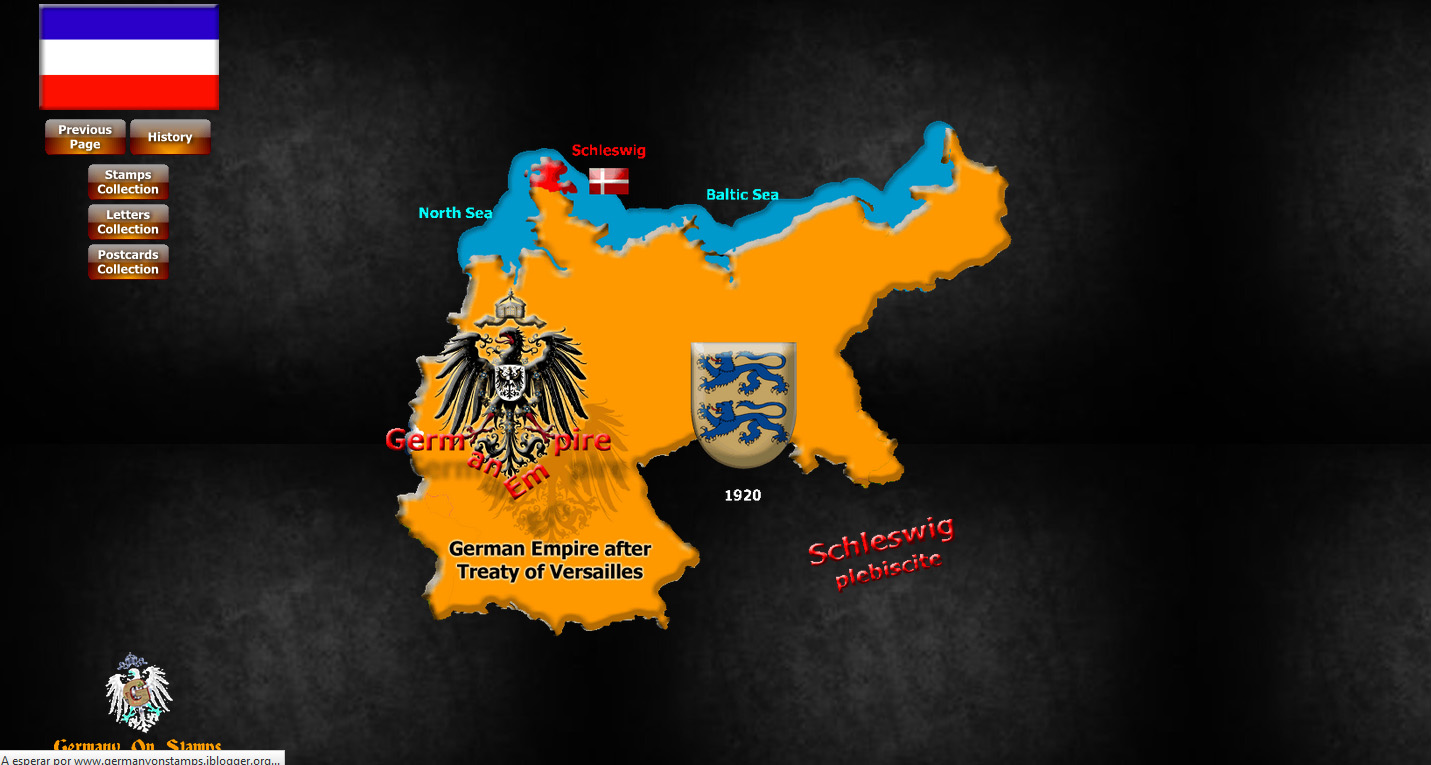
Germany on Stamps: Schleswig History

SCHLESWIG
 North and South Schleswig (in this map in red and orange, respectively)
Schleswig or Southern Jutland – in Danish "Sønderjylland" or "Slesvig", in German "Schleswig", in Low German "Sleswig" – is a region covering the area about 60 km north and 70 km south of the border between Germany and Denmark.
The Duchy of Schleswig, or Southern Jutland, was originally an integral part of Denmark, but was, in medieval times established as a fief under the Kingdom of Denmark, with the same relation to the Danish Crown as for example Brandenburg or Bavaria vis-à-vis the Holy Roman Emperor.
Feuds and marital alliances brought the Abel dynasty into a close connection with the German Duchy of Holstein by the 15th century. The latter was a fief subordinate to the Holy Roman Empire, while Schleswig remained a Danish fief. These dual loyalties were to become a main root of the dispute between the German states and Denmark in the 19thcentury, when the ideas of romantic nationalism and the nation-state won popular support.
Before World War I
Conflict between Denmark and German states over Schleswig and Holstein led to the Schleswig-Holstein Question of the 19thcentury. Denmark attempted to integrate the Duchy of Schleswig into the Danish kingdom in 1848, leading to an uprising of ethnic Germans who supported Schleswig's ties with Holstein. The military intervention of the Kingdom of Prussia supported the uprising: the Prussian army drove Denmark's troops from Schleswig and Holstein in the First Schleswig War of 1848–1851.
Denmark again attempted to integrate Schleswig in 1864, but the German Confederation defeated the Danes in the Second War of Schleswig. Prussia and Austria respectively assumed administration of Schleswig and Holstein under the Gastein Convention of 14 August 1865. However, tensions between the two powers culminated in the Austro-Prussian War of 1866. In the Peace of Prague, the victorious Prussians annexed Schleswig and Holstein, creating the province of Schleswig-Holstein.
Provision for the cession of northern Schleswig to Denmark was made pending a popular vote in favour of this. In 1878, however, Austria went back on this provision. Denmark with Germany, in a Treaty of 1907, recognized, by the agreement between Austria and Prussia, the frontier between Prussia and Denmark.
Schleswig Plebiscite after World War I

No vote ever took place in the southern third of Schleswig, because the result for Germany was predictable.
On June 15, 1920, Northern Schleswig officially returned to Danish rule. Germany continued to hold the whole of Holstein and southern and central Schleswig, later becoming the Prussian province of Schleswig-Holstein. The Danish-German border was the only one of the borders imposed on Germany following World War I which was never challenged by Hitler.
World War II

In the Second World War, after Nazi Germany occupied the whole of Denmark, there was agitation by local Nazi leaders in Schleswig-Holstein to restore the pre-World War I border and re-annex to Germany the areas granted to Denmark after the plebiscite — as the Nazis did in Alsace-Lorraine at the same period. However, Hitler vetoed any such step, out of a general Nazi policy at the time to base the occupation of Denmark on a kind of accommodation with the Danish Government, and avoid outright confrontations with the Danes.
After World War II
After Germany had lost World War II there again was a possibility that Denmark could reacquire some of its lost territory in Schleswig. Though no territorial changes came of it, it had the effect that Prime Minister Knud Kristensen was forced to resign after a vote of no confidence because the Folketing (Parliament of Denmark) did not support his enthusiasm for incorporating Southern Schleswig into Denmark.
Although there was, as a result, a Danish minority in Southern Schleswig and a German minority in Northern Schleswig, the minorities were granted rights to practice their language and culture, to such a degree that the division and minorities as of 2009 are not a political issue between Denmark and Germany.

Mar 2, 2013
Germany On Stamps: New Marienwerder Stamps

New Stamps from Marienwerder with Overprint "Comission Interalliée Marienwerder".
Novos Selos de Marienwerder com Impressão Sobreposta "Comission Interalliée Marienwerder".
Feb 23, 2013

Germany on Stamps: Eupen and Malmedy Stamp
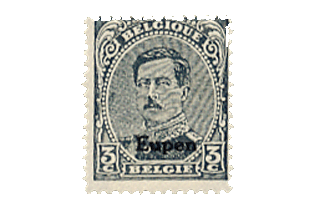
Novo Selo do Eupen e Malmedy.
Nov 25, 2012
Germany On Stamps: Eupen and Malmedy new set


New Set from Eupen and Malmedy (1920).
Nova Série do Eupen e Malmedy (1920).
Nov 10, 2012


Germany On Stamps: Danzig History

DANZIG HISTORY

 Danzig, today Gdansk, is a Polish city on the Baltic coast, at the centre of the country's fourth-largest metropolitan area. The city lies on the southern edge of Gdansk Bay (of the Baltic Sea), in a conurbation with the city of Gdynia, and suburban communities, which together form a metropolitan area called Trójmiasto, with a population of over 800,000. Gdansk itself has a population of 455,830 (June 2010), making it the largest city in the Pomerania region of Northern Poland.
Gdansk is Poland's principal seaport as well as the capital of the Pomeranian Voivodeship (administrative area). The city is close to the former late medieval/modern boundary between West Slavic and Germanic lands and it has a complex political history with periods of Polish rule, periods of German rule, and extensive self-rule, with two terms as a free city. It has been part of Poland since 1945.
Gdansk is situated at the mouth of the Motława River, connected to the Leniwka, a branch in the delta of the nearby Vistula River, whose waterway system supplies 60% of the area of Poland and connects Gdansk to the national capital in Warsaw. This gives the city a unique advantage as the centre of Poland's sea trade. Together with the nearby port of Gdynia, Gdansk is also an important industrial centre. Historically an important seaport and shipbuilding centre, Gdansk was a member of the Hanseatic League.
The city was the birthplace of the Solidarity movement which, under the leadership of political activist Lech Wałęsa, played a major role in bringing an end to Communist rule across Central Europe.
Brief History
Throughout its long history, Gdansk has faced various periods of rule by different states:
- 997 – 1308: as part of the Kingdom of Poland;
- 1308 – 1454: as part of the territory of the Teutonic Order;
- 1454 – 1466: Thirteen Years' War;
- 1466 – 1569: as part of the Kingdom of Poland;
- 1569 – 1793: as part of Polish–Lithuanian Commonwealth;
- 1793 – 1805: as part of Prussia;
- 1807 – 1814: as a free city;
- 1815 – 1871: as part of Prussia;
- 1871 – 1920: as part of Imperial Germany;
- 1920 – 1939: as a free city;
- 1939 – 1945: as part of Nazi Germany;
- 1945 – 1989: as part of Polish People's Republic;
- 1989 – to the present: as part of Republic of Poland.
 On 15 May 1457, Casimir IV of Poland granted Gdansk the Great Privilege, after he had been invited by the town's council and had already stayed in town for five weeks. With the Great Privilege, the town was granted autonomy within the Kingdom of Poland. Furthermore, the privilege united Old Town, Hakelwerk and Rechtstadt, and legalized the demolition of New Town, which had sided with the Teutonic Knights. Already in 1457, New Town was demolished completely.
Gaining free and privileged access for the first time to polish markets, the seaport prospered while simultaneously trading with the other hanseatic cities. After the Second Peace of Thorn in 1466 with the Teutonic Monastic State of Prussia, the warfare ended permanently. After the incorporation of Royal Prussia by the Kingdom of Poland in 1569, the city continued to enjoy a large degree of internal autonomy.
After the Siege of Danzig, in 1577, lasting six months, the city's army of 5,000 mercenaries was utterly defeated in a field battle on December 16. However, since Stephen's armies were unable to take the city by force, a compromise was reached: Stephen Báthory confirmed the city's special status and Danzig's Law privileges granted by earlier Polish kings.
 The city suffered a slow economic decline due to the wars of the 18th century, when it was taken by the Russians after the Siege of Danzig in 1734.
Danzig was annexed by the Kingdom of Prussia in 1793. During the era of Napoleon Bonaparte the city became a free city in the period extending from 1807 to 1814.
From 1824 until 1878, East and West Prussia were combined as a single province within the Prussian Kingdom. As a part of Prussia Danzig was a member of the Zollverein and elected its representatives to the German National Assembly of 1848, but lay outside of the borders the German Confederation (1815–1866). In the second half of 19th century the growth of German population in the city was being slowly reversed, with more Poles settling in, mainly from Pomerania, and parts of local population discovering their Polish roots.
In 1871 the city was included in the newly created German Empire.
Free City
The Free City of Danzig was a semi-autonomous city-state that existed between 1920 and 1939. It consisting of the Baltic Sea port of Danzig and surrounding areas.
The Free City was created on 15 November 1920 in accordance with the terms of Part III, Section XI of the Treaty of Versailles of 1919, without a plebiscite. The Free City included the city of Danzig and over two hundred nearby towns, villages and settlements.
 As the League of Nations decreed, the region was to remain separated from the nation of Germany, and from the newly resurrected nation of Poland. The Free City was not an independent State; it was under League of Nations protection and put into a binding customs union with Poland. Poland also had special utilization rights towards the city. The Free City was created in order to give Poland sufficient access to the sea.
In 1933, the City's government was taken over by the local Nazi Party and the democratic opposition was suppressed.
After the German invasion of Poland in 1939, the Free City was abolished and incorporated into the newly formed Reichsgau (an administrative subdivision) of Danzig-West Prussia. Widespread anti-Semitic and anti-Polish discrimination and organized murder followed.
Before the end of World War II, the Yalta Conference had agreed to place the city, under its original Polish name Gdansk, under de facto administration of Poland. This decision was confirmed at the Potsdam Conference.
A Polish administration was set up in the devastated Gdansk on 30 March 1945. As of 1948 more than two thirds of the 150,000 inhabitants came from Central Poland, about 15 to 18 percent from Polish-speaking areas east of the Curzon Line that were annexed by the Soviet Union after WWII.
Between 1952 and the late 1960s Polish artisans restored much of the old city's architecture, up to 90% destroyed in the war.
Gdansk was the scene of anti-government demonstrations which led to the downfall of Poland's communist leader Władysław Gomułka in December 1970, and ten years later was the birthplace of the Solidarity trade union movement, whose opposition to the government led to the end of communist party rule, in 1989, and the election as president of Poland of its leader Lech Wałęsa. It remains today a major port and industrial city.
Postage stamps and postal history of Free City of Danzig
Danzig, when was a Free City, had its own stamps.
The first stamps of Danzig were overprinted German stamps issued on 14 June 1920.
The first stamps of the Danzig Free State appeared in January 1921 and continued in use until the outbreak of World War II in 1939. At that time the Free City was annexed by the Third Reich.
Aug 1, 2012
Germany On Stamps: Upper Silesia Pages

New pages from theme "German Empire after Treaty of Versailles. This time the Upper Silésia stamps, letters and Postcards pages.
Novas páginas do tema "O Império Alemão após o Tratado de Versalhes". Desta vez as páginas de Selos, Cartas e Postais da Alta Silésia.
Germany on Stamps: Upper Silesia History

UPPER SILESIA HISTORY
 Upper Silesia is the southeastern part of the historical and geographical region of Silesia. The region is situated on the upper Oder River, north of the Eastern Sudetes mountain range and the Moravian Gate, which form the southern border with the historic Moravia region. Within the adjacent Silesian Beskids to the east, the Vistula River rises and turns eastwards; the Biała and Przemsza tributaries mark the eastern border with Lesser Poland. In the north, Upper Silesia borders on Greater Poland and in the west on the Lower Silesian lands, the adjacent region around Wrocław also referred to as Middle Silesia.
It is currently split into a larger Polish and the smaller Czech Silesian part, which is located within the Czech regions of Moravian-Silesia and Olomouc. The Polish Upper Silesian territory covers most of the Opole Voivodeship ("Opole Silesia"), except for the Lower Silesian counties of Brzeg and Namysłów, and the Silesian Voivodeship, except for the Lesser Polish counties of Będzin, Bielsko (eastern part), Częstochowa with the city of Częstochowa, Kłobuck, Myszków, Zawiercie and Żywiec as well as the cities of Dąbrowa Górnicza, Jaworzno and Sosnowice.
History
Since the 9th century, Upper Silesia has been part of the Great Moravia, the Duchy of Bohemia, the Piast Kingdom of Poland, again of the Lands of the Bohemian Crown and the Holy Roman Empire, as well as of the Habsburg Monarchy from 1526.
Upon the death of the Jagiellonian king Louis II in 1526, the Bohemian crown lands were inherited by the Austrian House of Habsburg.
 In the 16th century, large parts of Silesia had turned Protestant. After the 1620 Battle of White Mountain, the Catholic Emperors of the Habsburg dynasty forcibly re-introduced Catholicism, led by the Jesuits.
Lower Silesia and most of Upper Silesia were occupied by the Kingdom of Prussia in 1742 during the First Silesian War and annexed by the terms of the Treaty of Breslau (Wroclaw). A small part south of the Opava River remained within the Habsburg-ruled Bohemian Crown as the "Duchy of Upper and Lower Silesia", colloquially called Austrian Silesia. Incorporated into the Prussian Silesia Province from 1815, Upper Silesia became an industrial area taking advantage of its plentiful coal and iron ore. Prussian Upper Silesia became a part of the German Empire in 1871.
After World War I, in 1919, the eastern part of Prussian Upper Silesia (with a majority of ethnic Poles) came under Polish rule as the Silesian Voivodeship, while the mostly German-speaking western part remained part of the German Reich as the newly established Upper Silesia Province.

From 1919-1921 three Silesian Uprisings occurred among the Polish-speaking populace of Upper Silesia.
In the Upper Silesia plebiscite of March 1921, a majority voted against merging with Poland, with clear lines dividing Polish and German communities. On June 20, Germany ceded, de facto, the eastern parts of Upper Silesia, becoming part of Silesian Voivodeship of the Second Polish Republic.
After 1945, almost all of Upper Silesia that was not ceded to Poland in 1922 was transferred to the Republic of Poland.
A majority of the German-speaking population was expelled in accordance with the decision of the victorious Allied powers at their 1945 meeting at Potsdam. This expulsion program also included German speaking inhabitants of Lower Silesia, eastern Pomerania, Gdańsk (Danzig), and East Prussia. The German expellees were transported to the present day Germany (including the former East Germany), and they were replaced with Poles, many from former Polish provinces taken over by the USSR in the east.
With the fall of communism and Poland joining the European Union, there were enough of these remaining in Upper Silesia to allow for the recognition of the German minority in Poland by the Polish government.
Upper Silesia Plebiscite
 After the First World War, Poland laid claim to Upper Silesia, which had been part of Prussia. The Treaty of Versailles had recommended a plebiscite in Upper Silesia to determine whether the territory should become part of Germany or Poland.
Complaints about the attitude of the German authorities led to rioting and eventually to the first of two Silesian Uprisings.
A plebiscite took place on 20 March 1921, with 59.6 percent of the votes cast in favour of joining Germany. Poland claimed the conditions surrounding it had been unfair. This result led to the Third Silesian Uprising in 1921.
On 12 August 1921, the League was asked to settle the matter. The committee recommended that Upper Silesia be divided between Poland and Germany according to the preferences shown in the plebiscite and that the two sides should decide the details of the interaction between the two areas – for example, whether goods should pass freely over the border due to the economic and industrial interdependency of the two areas.
In November 1921, a conference was held in Geneva to negotiate a convention between Germany and Poland. A final settlement was reached, after five meetings, in which most of the area was given to Germany, but with the Polish section containing the majority of the region's mineral resources and much of its industry.
The exact border, the maintenance of cross-border railway traffic and other necessary co-operations, as well as equal rights for all inhabitants in both parts of Upper Silesia, were all fixed by the German-Polish Accord on East Silesia, signed in Geneva on May 15, 1922.
When this agreement became public in May 1922, bitter resentment was expressed in Germany, but the treaty was still ratified by both countries. The settlement produced peace in the area until the beginning of the Second World War.
It is currently split into a larger Polish and the smaller Czech Silesian part, which is located within the Czech regions of Moravia-Silesia and Olomouc. The Polish Upper Silesian territory covers most of the Opole Voivodeship ("Opole Silesia"), except for the Lower Silesian counties of Brzeg and Namysłów, and the Silesian Voivodeship, except for the Lesser Polish counties of Będzin, Bielsko (eastern part), Częstochowa with the city of Częstochowa, Kłobuck, Myszków, Zawiercie and Żywiec as well as the cities of Dąbrowa Górnicza, Jaworzno and Sosnowice.
Divided Cieszyn Silesia as well as former Austrian Silesia is historical parts of Upper Silesia.
German Empire after Treaty of Versailles: General History

WORLD'S CHANGES AFTER WWI
 The fighting in World War I ended in Western Europe when the Armistice took effect at 11:00 am GMT on November 11, 1918, and in Eastern Europe by the early 1920s. During and in the aftermath of the war, the political, cultural, and social order was drastically changed in Europe, Asia and Africa, even outside the areas directly involved in the war. New countries were formed, old ones were abolished, international organizations were established, and many new and old ideologies took a firm hold in people's minds.
Blockade of Germany
Throughout the period from the armistice on November 11, 1918 until the signing of the peace treaty with Germany on June 28, 1919, the Allies maintained the naval blockade of Germany that had begun during the war. As Germany was dependent on imports, it is estimated that 523,000 civilians had lost their lives during the war, and a quarter-million more died from disease or starvation in this eight month period.
The terms of the Armistice did allow food to be shipped into Germany, but the Allies required that Germany provide the ships. The German government was required to use its gold reserves, being unable to secure a loan from the United States.
The blockade was not lifted until early July 1919 when the Treaty of Versailles was signed by most of the combatant nations.
Treaty of Versailles
 After the Paris Peace Conference of 1919, the signing of the Treaty of Versailles on June 28, 1919, between Germany on the one side and France, Italy, Britain and other minor allied powers on the other side, officially ended war between those countries. Other treaties ended the belligerent relationships of the United States and the other Central Powers.
Included in the 440 articles of Treaty of Versailles were the demands that Germany officially accept responsibility for starting the war and pay heavy economic reparations. This treaty drastically limited the German military machine: the German troops were reduced to 100,000 and the country was prevented from possessing major military armament such as tanks, warships, and submarines.
Economic and Geopolitical consequences
 There were some general consequences from the creation of a large number of new small states in Eastern Europe as a result of the dissolution of the German, Russian, Austro-Hungarian, and (a little earlier) Ottoman empires, and the regional disturbance of the Russian Civil War. Internally these new states tended to have substantial ethnic minorities, which wished to unite with neighbouring states where their ethnicity dominated.
The League of Nations sponsored various Minority Treaties in an attempt to deal with the problem, but with the decline of the League in the 1930s these treaties became increasingly unenforceable. One consequence of the massive redrawing of borders and the political changes in the aftermath of World War I was the large number of European refugees.
Economic and military cooperation amongst these small states was minimal ensuring that the defeated powers of Germany and the Soviet Union retained a latent capacity to dominate the region. In the immediate aftermath of the war, defeat drove cooperation between Germany and the Soviet Union but ultimately these two powers would compete to dominate Eastern Europe.
What's changed in Germany after WWI
 In Germany, there was a socialist revolution which led to the brief establishment of a number of communist political systems in (mainly urban) parts of the country, the abdication of the Kaiser, and the creation of the Weimar Republic.
On 28 June 1919, Germany, which was not allowed representation, was not present to sign the Treaty of Versailles. Germany was forced to pay 132 billion marks ($31.5 billion, 6.6 billion pounds) in reparations (a very large amount for its day which was finally paid off in October, 2010). It was followed by the Inflation in the Weimar Republic, a period of hyperinflation in Germany between 1921 and 1923. On December 1922 the Reparations Commission declared Germany in default, and on 11 January 1923 French and Belgian troops occupied the Ruhr until 1925.
Germany saw relatively small amounts of territory transferred to Denmark, Czechoslovakia, and Belgium, a larger amount to France and the greatest portion as part of re-established Poland.
Germany's overseas colonies were divided amongst a number of Allied countries. It was the loss of territory that now constituted part of Poland that caused by far the greatest resentment. Nazi propaganda would feed on a general German view that the treaty was unfair—many Germans never accepted the treaty as legitimate, and later gave their political support to Adolf Hitler, who was arguably the first national politician to both speak out and take action against the treaty's conditions.
Territorial gains and losses after World War I
Nations that gained territory:
- Yugoslavia (as the successor state of the Kingdom of Serbia);
- Romania, Greece, France, Italy, Denmark, Belgium, Czechoslovakia, Poland, Estonia, Latvia, Lithuania, and United Kingdom, with League of Nations Mandates;
- Japan.
Nations that lost territory:
- Germany – forced to give it up after the Treaty of Versailles;
- Weimar Germany (as the successor state of the German Empire);
- China – Jiaozhou Bay and most of Shandong in North China forcibly ceded to the Japanese Empire;
- Russian SFSR (as the successor state of the Russian Empire);
- Austria (as the successor state of Cisleithania and the Austro-Hungarian Empire);
- Hungary (as the successor state of Transleithania and the Austro-Hungarian Empire);
- Turkey (as the successor state of the Ottoman Empire);
- Bulgaria;
- United Kingdom – most of Ireland as the Irish Free State.
TREATY OF VERSAILLES
 The Treaty of Versailles was one of the peace treaties at the end of World War I. It ended the state of war between Germany and the Allied Powers. It was signed on 28 June 1919, exactly five years after the assassination of Archduke Franz Ferdinand. The other Central Powers on the German side of World War I were dealt with in separate treaties.
Although the armistice signed on 11 November 1918 ended the actual fighting, it took six months of negotiations at the Paris Peace Conference to conclude the peace treaty.
Of the many provisions in the treaty, one of the most important and controversial required Germany to accept sole responsibility for causing the war and, under the terms of articles 231–248 (later known as the War Guilt clauses), to disarm, make substantial territorial concessions and pay reparations to certain countries that had formed the Entente powers. The total cost of these reparations was assessed at 132 billion marks (then $31.4 billion, £6.6 billion) in 1921.
CONTENT
Impositions on Germany
Legal restrictions
- Article 227 charges former German Emperor, Wilhelm II, with supreme offense against international morality. He is to be tried as a war criminal.
- Articles 228–230 tried many other Germans as war criminals.
- Article 231 (the "War Guilt Clause") lays sole responsibility for the war on Germany, which is to be accountable for all damage to civilian populations of the Allies.
Military restrictions
 Part V of the treaty begins with the preamble: "In order to render possible the initiation of a general limitation of the armaments of all nations, Germany undertakes strictly to observe the military, naval and air clauses which follow...".
Germany was also forbidden to unite with Austria to form a larger Nation to make up for the lost land.
- The Rhineland will become a demilitarized zone administered by Great Britain and France jointly.
- German armed forces will number no more than 100,000 troops, and conscription will be abolished.
- Enlisted men will be retained for at least 12 years; officers to be retained for at least 25 years.
- German naval forces will be limited to 15,000 men, 6 battleships, 6 cruisers, 6 destroyers and 12 torpedo boats. No submarines are to be included.
- The manufacture, import and export of weapons and poison gas are prohibited.
- Armed aircraft, tanks and armoured cars are prohibited.
- Blockades on ships are prohibited.
- Restrictions on the manufacture of machine guns and rifles.
Territorial changes

Germany's borders in 1919 had been established nearly a half-century earlier, at the country's official establishment in 1871. Territory and cities in the region had changed hands repeatedly for centuries, including at various times being owned by the Austro-Hungarian Empire, Kingdom of Sweden, Kingdom of Poland, and Kingdom of Lithuania. However, Germany laid claim to lands and cities that it viewed as historically "Germanic" centuries before Germany's establishment as a country in 1871. Other countries disputed Germany's claim to this territory. In the peace treaty, Germany agreed to return disputed lands and cities to various countries.
Germany was compelled to yield control of its colonies, and would also lose a number of European territories.
The province of West Prussia would be ceded to the restored Poland, thereby granting it access to the Baltic Sea via the "Polish Corridor" which Prussia had annexed in the Partitions of Poland. This turned East Prussia into an exclave, separated from mainland Germany.
- Alsace and much of Lorraine, both originally German-speaking territories, were part of France, having been annexed by France's King Louis XIV who desired the Rhine as a natural border. After approximately two centuries of French rule, Alsace and the German-speaking part of Lorraine were ceded to Germany in 1871 under the Treaty of Frankfurt. In 1919 both regions were returned to France.
- Northern Schleswig was returned to Denmark following a plebiscite on 14 February 1920. Central Schleswig, including the city of Flensburg, opted to remain German in a separate referendum on 14 March 1920.
- Most of the Prussian provinces of Province of Posen (now Poznan) and of West Prussia which Prussia had annexed in the Partitions of Poland (1772–1795) were ceded to Poland without a plebiscite. Most of the Province of Posen had already come under Polish control during the Great Polish Uprising of 1918–1919.
- The Hultschin area of Upper Silesia was transferred to Czechoslovakia without a plebiscite.
- The eastern part of Upper Silesia was assigned to Poland, despite the Upper Silesia plebiscite resulting in 717,122 votes being cast for Germany and 483,514 for Poland.
- The area of the towns Eupen and Malmedy went to Belgium despite a plebiscite to the contrary. The Vennbahn railway was also transferred to Belgium.
- The area of Soldau in East Prussia, an important railway junction on the Warsaw-Danzig route, was transferred to Poland without a plebiscite.
- The northern part of East Prussia known as the Memelland or Memel Territory was placed under the control of France and was later annexed by Lithuania.
- From the eastern part of West Prussia and the southern part of East Prussia, after the East Prussian plebiscite a small area was ceded to Poland.
- The province of Saarland was to be a under the control of the League of Nations for 15 years, after which a plebiscite between France and Germany, was to decide to which country it would belong. During this time, coal would be sent to France.
- The strategically important port of Danzig with the delta of the Vistula River on the Baltic Sea was separated from Germany as the Freie Stadt Danzig (Free City of Danzig). This created the so-called Polish Corridor, giving Poland access to the sea.
- Austria was forbidden from merging with Germany.
- In article 22, German Colonies were divided between Belgium, the United Kingdom, and certain British Dominions, France, and Japan with the determination not to see any of them returned to Germany — a guarantee secured by Article 119.
In Africa, Britain and France divided German Kamerun (Cameroons) and Togoland. Belgium gained Ruanda-Urundi in northwestern German East Africa. Great Britain obtained by far the greater landmass of this colony, thus gaining the 'missing link' in the chain of British possessions stretching from South Africa to Egypt (Cape to Cairo). Portugal received the Kionga Triangle, a sliver of German East Africa. German South West Africa was mandated to the Union of South Africa.
In the Pacific, Japan gained Germany's islands north of the equator (the Marshall Islands, the Carolines, the Marianas and the Palau Islands) and Kiauchau in China.
German Samoa was assigned to New Zealand. German New Guinea, the Bismarck Archipelago and Nauru to Australia as mandatory.
Mar 5, 2012
Germany on Stamps: Marienwerder (New pages)

MARIENWERDER - KWIDZYN HISTORY
Kwidzyn, formerly Marienwerder, is a town in northern Poland on the Liwa River. It extends over an area of 22 square kilometres, with 39 930 inhabitants, according to the 2007 census. It has been a part of the Pomeranian Voivodeship since 1999. It is the capital of Kwidzyn County.
History
The Teutonic Knights founded an Ordensburg (fortress built by crusading German military orders) castle in 1232 and a town the following year. This new settlement of Marienwerder became the seat of the Bishops of Pomesania within Prussia.
History
The Teutonic Knights founded an Ordensburg (fortress built by crusading German military orders) castle in 1232 and a town the following year. This new settlement of Marienwerder became the seat of the Bishops of Pomesania within Prussia.
The town was populated with Masurian settlers from the Duchy of Masovia. Werner von Orseln (the 17th Grand Master of the Teutonic Order), who died in Marienburg (Malbork) in 1330, was buried in the cathedral of Marienwerder. St. Dorothea of Montau lived in Marienwerder from 1391 until her death in 1394. The rebellious Prussian Confederation was founded in Marienwerder on March 14, 1440.
In 1466, the town became a Polish fief together with the remainder of the monastic state of the Teutonic Knights after their defeat in the Thirteen Years' War.
Marienwerder became part of the Duchy of Prussia, a fief of Poland, upon its creation in 1525. The duchy was inherited by the House of Hohenzollern in 1618 and was elevated to the Kingdom of Prussia in 1701. The town became the capital of the District of Marienwerder. After the First Partition of Poland, Marienwerder became an administrative seat of the new Prussian Province of West Prussia. The town and district were included within the government region of Marienwerder after the Napoleonic Wars.
After 1871, when Marienwerder was included in the newly created German Empire, the "Kulturkampf", a German anticlerical movement of the 19th century, was aimed mainly at Catholics. In 1885 Marienwerder had 8,079 mostly Lutheran inhabitants, many of whose trades were connected with the manufacturing of sugar, vinegar, and machines. Other trades were brewing, dairy farming, and fruit-growing.
After World War I, the Treaty of Versailles transferred most of West Prussia to the Polish Second Republic. The treaty permitted the East Prussian plebiscite in a few areas, to determine if Marienwerder would remain in Germany as part of East Prussia or join Poland. The inhabitants of the town voted on 11 July 1920 for East Prussia.
During the Weimar Republic, a Polish high school was founded in the town. On August 25, 1939, pupils of the school were deported to Nazi concentration camps.
In 1945 during World War II, Marienwerder was plundered by the Soviet Red Army. Red Army established war hospital in the town for 20,000 people. The town's old centre was burned by Soviet soldiers. The post-war Potsdam Conference placed it under Polish administration in 1945. Since then it remains as part of Poland. Burned parts of the town's old centre were dismantled to provide material for the rebuilding of Warsaw after its destruction in the Warsaw Uprising.
The Plebiscite

The Marienwerder plebiscite was a plebiscite for self-determination of the region, in accordance to the Treaty of Versailles. Prepared during early 1920, it took place on 11 July 1920. The majority of voters selected East Prussia over Poland, with about 92% of the votes.
In accordance with Articles 94 to 97 of the Treaty of Versailles, section entitled "East Prussia", the territory of the plebiscite was formed by Marienwerder (now Kwidzyn) district, which encompassed counties of Stuhm (Sztum), Rosenberg in Westpreußen (Susz) as well as parts of counties of Marienburg (Malbork), east off the Nogat River and Marienwerder (east of the Vistula River).
In accordance with Articles 94 to 97 of the Treaty of Versailles, section entitled "East Prussia", the territory of the plebiscite was formed by Marienwerder (now Kwidzyn) district, which encompassed counties of Stuhm (Sztum), Rosenberg in Westpreußen (Susz) as well as parts of counties of Marienburg (Malbork), east off the Nogat River and Marienwerder (east of the Vistula River).
The treaty defined the area as "The western and northern boundary of Regierungsbezirk Allenstein (Allenstein district) to its junction with the boundary between the Kreis (district) of Oletzko (Olecko) and Angerburg (Węgorzewo); thence, the northern boundary of the Kreis of Oletzko to its junction with the old frontier of East Prussia."
Jan 29, 2012
Eupen & Malmedy Pages

At the beginning of World War I, most of the inhabitants of the Eupen and Malmedy districts considered themselves German and fought for the German Empire during the war. In 1920, the Treaty of Versailles awarded all the communities of Eupen, Malmedy and Sankt Vith, on a provisional basis to Belgium.
These new pages show some stamps and letters from that period.No início da Primeira Guerra Mundial, a maioria dos habitantes dos distritos de Eupen e Malmedy consideravam-se Alemães e lutaram pelo Império Alemão durante a guerra. Em 1920, o Tratado de Versalhes concedeu provisoriamente todas as comunidades de Eupen, Malmedy e Sankt Vith, à Bélgica.
Estas novas páginas mostram alguns selos e cartas desse período.
Estas novas páginas mostram alguns selos e cartas desse período.

New Allenstein Postcard

New 1920 Postcard from Allenstein/Olsztyn.
Novo Postal de 1920 do Allenstein/Olsztyn.
Dec 23, 2011
New Theme - Germany after Treaty of Versailles

New Theme: "The German Empire after Treaty of Versailles".
After the First World War, with the defeat of Germany, the Peace Conference, held in Paris in 1919, came to rule by the "Treaty of Versailles" a set of penalties to Germany which resulted, among others, in conducting Plebiscites and placement of part of German territory under the League of Nations mandate and delivered to the administration of the winning countries.
These decisions resulted in the loss of large parts of the former German Empire territory, including all of the German Colonies.
At this point only two sub-themes were included in this Theme (Allenstein, reformulated and adapted to the new theme, and Danzig). Soon others will follow (Eupen & Malmedy, Marienwerder, Upper Silesia, Memel, Saarland and Schleswig).
Novo tema: "O Império Alemão após o Tratado de Versalhes".
Após a Primeira Guerra Mundial e com a derrota da Alemanha, a Conferência de Paz, realizada em Paris em 1919, veio decidir através do "Tratado de Versalhes" um conjunto de penalizações para a Alemanha que se traduziram, entre outras, na realização de Plebiscitos e colocação de parte do território alemão sob mandato da Sociedade das Nações e entregues à administração dos países vencedores.
Destas decisões resultaram a perda de grandes partes territoriais do extinto Império Alemão, incluindo a totalidade das Colónias Alemãs.
Neste momento apenas incluímos dois sub-temas neste Tema (Allenstein, reformulado e adaptado ao novo tema e Danzig). Em breve outros se lhe seguirão (Eupen & Malmedy, Marienwerder, Alta Silésia, Memel, Sarre e Schleswig).
Destas decisões resultaram a perda de grandes partes territoriais do extinto Império Alemão, incluindo a totalidade das Colónias Alemãs.
Neste momento apenas incluímos dois sub-temas neste Tema (Allenstein, reformulado e adaptado ao novo tema e Danzig). Em breve outros se lhe seguirão (Eupen & Malmedy, Marienwerder, Alta Silésia, Memel, Sarre e Schleswig).


