The Collecting Adventure

The Pleasure of Collecting.

African Ethnic Stamps and Postcards

A Ethnic view of Africa. The Richness and Beauty of African Culture and People.

Germany - History On Stamps

100 years of German History told in Stamps, Letters and Postcards.

French Stamps

The Culture and the History of France in Stamps.

The Virtual Art Museum

The Art in Stamps. Painting, Sculpture and Art Personalities in a Virtual Philatelic Museum.

Showing posts with label Stamps/Selos. Show all posts

Mar 2, 2013

Germany On Stamps: New Marienwerder Stamps


New Stamps from Marienwerder with Overprint "Comission Interalliée Marienwerder".

Novos Selos de Marienwerder com Impressão Sobreposta "Comission Interalliée Marienwerder".  


Jan 26, 2013

Germany On Stamps: German Colonies Stamps (Togoland)


New 1915 German Togo (Togoland) Stamps. Those Stamps are from the British occupation of german colonie Togoland during the World War I.

Novos Selos de 1915 do Togo Alemão (Togoland). Estes Selos foram usados durante a ocupação Britânica da colónia alemã do Togo no decurso da Primeira Guerra Mundial.


Jan 1, 2013

Germany On Stamps: German Cameroon Stamps


New German Cameroon Stamps. These stamps are from british occupation of the territory, at World War I (1915).The overprint "C.E.F." means (Cameroons Expeditionary Forces).

Novos selos dos Camarões Alemão. estes selos foram usados durante a ocupação britânica durante a Primeira Guerra Mundial (1915). A impressão sobreposta "C.E.F." significa"Forças Expedicionárias nos Camarões" (Cameroons Expeditionary Forces).

Dec 30, 2012

Stamps of France: 1943 French Coat-of-Arms Set


New set from 1943. French Coat-of-Arms from Ile-de-France, Lyonnais, Britany and Provence.


Nova série de 1943. Brasões-de-Armas da Ilha-de-França, Lyonnais, Bretanha e Provença.


Dec 22, 2012

Germany on Stamps: Weimar Republic Series


New series from 1926 (Weimar Republic). The set comprises four stamps bearing the Coat-of-Arms of Württemberg, Baden, Hesse and Thuringia.

Nova série de 1926 (República de Weimar). O conjunto é composto por quatro selos com o Brasão-de-Armas de Vurtemberga, Baden, Hesse e Turíngia. 


Dec 2, 2012

Germany On Stamps: 1936 Third Reich Stamps


Sheet from Third Reich with Stamps from 1936 Olympic Games.

Página do Terceiro Reich com Selos comemorativos dos Jogos Olímpicos Munique em 1936.

Nov 25, 2012

Germany On Stamps: Eupen and Malmedy new set


New Set from Eupen and Malmedy (1920).

Nova Série do Eupen e Malmedy (1920). 


Nov 18, 2012

Germany On Stamps: Weimar Republic Stamp


New Weimar Republic Stamps. This stamp belongs to 1920's "German Empire VI" Set.

Novo Selo da República de Weimar. Este Selo pertence à Série de 1920, "Império Alemão VI".


Nov 10, 2012

Germany On Stamps: Danzig Stamps


New Stamps from Danzig (1920).

Novos Selos de Danzig (1920).


Nov 4, 2012

Germany On Stamps: New Third Reich Stamps

New complete Set from Third Reich (1934). This set has two important figures of aviation pioneers, Ferdinand von Zeppelin and Otto Lilienthal.

Nova Série completa do Terceiro Reich (1934). Esta série apresenta duas figuras importantes dos pioneiros da aviação, Ferdinand von Zeppelin e Otto Lilienthal.


Oct 15, 2012

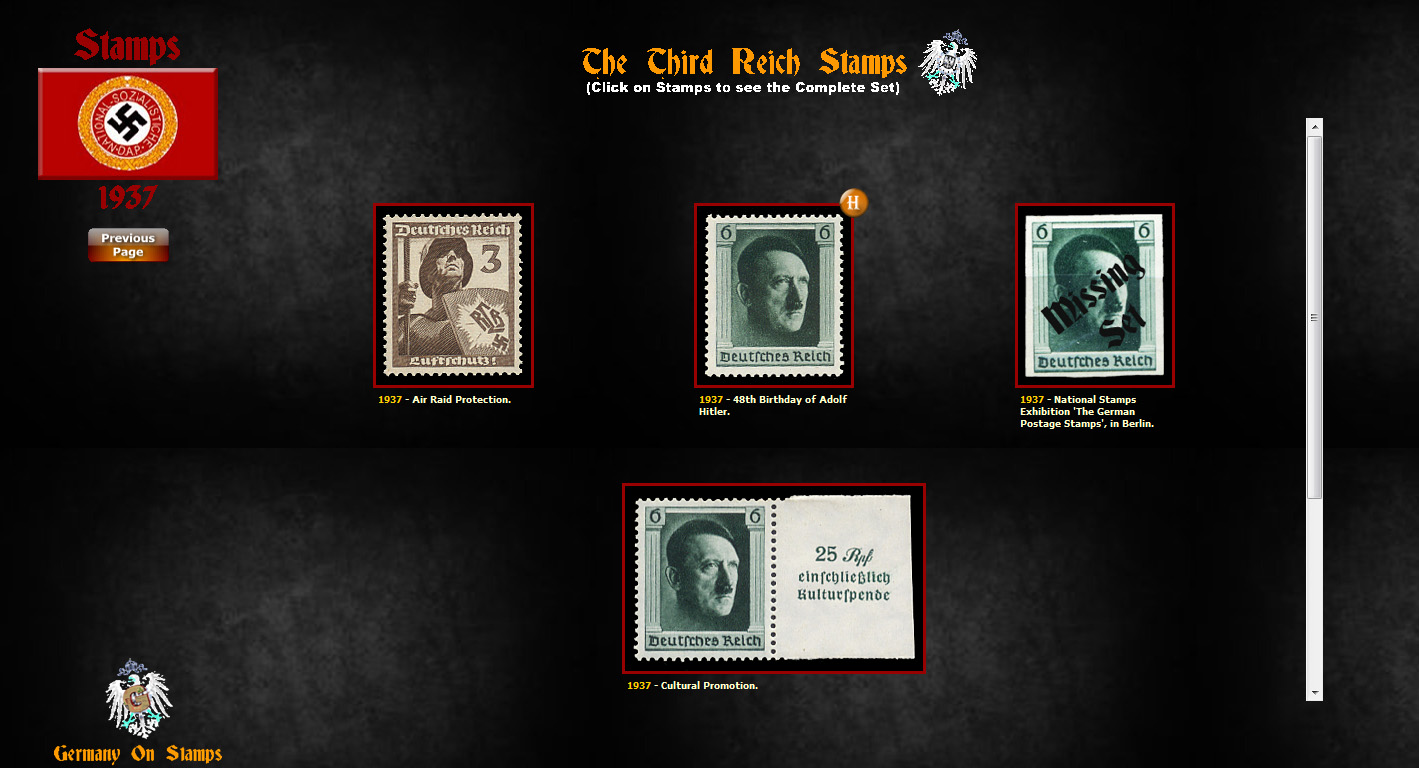
Germany on Stamps: Third Reich 1937 Pages


New "Third Reich" theme pages. Now we publish 1937 Stamps, Letters, Postcards and Blocks pages.

Novas páginas do tema "Terceiro Reich". Publicamos agora as páginas de 1937, contendo Selos, Cartas, Postais e Blocos.


Jul 5, 2012

Stamps of France: New 1942 Set


New Complete Set from Vichy France (1942).

Nova Série Completa da república de Vichy (1942).

May 27, 2012

Germany on Stamps: Hermann Wissmann


HERMANN VON WISSMANN

(4 September 1853 – 15 June 1905)


Leopold Wilhelm Ludwig Hermann Wissmann was a German explorer, officer and colonial administrator. He worked as an explorer of Africa, among other things on behalf of the Belgian king from 1883 to 1885, and crossed Africa from the Congo to the Zambezi River estuary.

Born in Frankfurt an der Oder, a town in Brandenburg, Germany, Wissmann was enlisted in the Army in 1870 and was commissioned a Lieutenant four years later. Wissmann served Mecklenburg in Füsilierregiment "Fusilier regiment" No. 90 posted at Rostock. During this time he had to serve a four month prison sentence for wounding an opponent in a duel. An 1879 chance meeting with the explore Dr. Paul Pogge changed his life.

Granted a leave of absence from the army, in 1880, Wissmann accompanied explorer Paul Pogge on a journey through the Congo Basin. In the eastern Congo, Pogge and Wissmann parted company. Pogge stayed to build an agricultural research station for a Congolese chief, while Wissmann trekked to the Indian Ocean via present-day Tanzania. Afterwards Wissmann was in the employ of King Leopold II of Belgium, who was in the process of creating his personal African empire, known as the Congo Free State.

In March 1883 Wissmann gave the name "Zappo Zap" to a Songye leader known as Nsapu Nsapu who ruled over the town of Mpengie, part of the Ben'Eki kingdom in the eastern Kasai region. This was a settlement with more than a thousand people, many of them slave warriors, to the east of the Sankuru River between Kabinda and Lusambo. Zappo Zap's people became allies and auxiliaries of the Congo Free State authorities. In 1899 they were sent out by the colonial administration to collect taxes. They massacred many villagers, causing an international outcry.

When in 1888 the attempts of the German East Africa Company to start a dominion collapsed in face of African resistance, it asked Bismarck for help, which was at first refused. In 1889, Wissmann was promoted to Captain and appointed as Reichskommissar (Imperial Commissioner) for the German East Africa region where he was tasked with suppression of the Abushiri Revolt led by Abushiri ibn Salim al-Harthi. Wissmann was only given one order: "Victory".

On his way to East Africa Wissmann hired a mercenary force of mostly Sudanese soldiers from decommissioned units of the Anglo-Egyptian army to whom later a number of Zulus from South Africa were added, all under the command of German officers. The German forces, along with British naval assistance, fortified Bagamoyo, Dar es Salaam and retook Tanga and Pangani.

Wissmann's forces with superior firepower also retook the rest of the Coastal Strip. They fortified the interior garrison of Mpwapwa and reopened the main caravan route. Soon afterwards, Abushiri was arrested and executed in Pangani on 16 December 1889. In January 1890, Wissmann issued a general pardon to the remaining rebels.

Wissmann was promoted to Major in 1890 and given a hero's welcome on his return to Germany. In 1891 he was nammed Commissioner for the western region of German East Africa and became Governor in 1895. Ill health forced him to return to Germany in 1896 where he authored several books and lectured throughout Germany.

He died in a hunting accident in Weissbach near Liezen, Styria, on 15 June 1905.

Germany on Stamps: Gustav Nachtigal


GUSTAV NACHTIGAL


(23 February 1834 – 20 April 1885)


Gustav Nachtigal was a surgeon, a Lutheran pastor and a German explorer of Central and West Africa. He was further known as the German Empire's consul-general for Tunisia and Commissioner for West Africa. His mission as commissioner resulted in Togoland and Kamerun becoming the first colonies of a German colonial empire. The Gustav-Nachtigal-Medal, awarded by the Berlin Geographical Society, is named after him.

Gustav Nachtigal, the son of a Lutheran pastor, was born at Eichstedt in the Prussian province of Saxony-Anhalt. After medical studies at the universities of Halle, Würzburg and Greifswald, he practiced for several years as a military surgeon. Finding the climate of his native country increasingly detrimental to his health, he went to Algiers and Tunis in North Africa and took part, as a surgeon, in several expeditions into Central Africa.

Commissioned by King Wilhelm I of Prussia to carry gifts to Umar of Borno, sheik of the Bornu Empire, in acknowledgment of kindness shown to German travelers, he set out in 1869 from Ottoman Tripoli and succeeded after a two years journey in accomplishing his mission. During this period he visited Tibesti and Borku, regions of the central Sahara not previously known to Europeans.

From Bornu he traveled to Baguirmi, an independent state to the southeast of Bornu. From there he proceeded to Wadai (a powerful Muslim kingdom to the northeast of Baguirmi) and to Kordofan (a former province of central Sudan).

Nachtigal emerged from darkest Africa at Khartoum (then an Egyptian outpost, today the capital of Sudan) in the winter of 1874, after having been given up for lost. His journey, graphically described in his Sahara and Sudan, placed him in the top ranking of discoverers.

After the establishment by France of a protectorate over Tunisia, Nachtigal was sent as consul-general for the German Empire and remained there until 1884. Thereafter he was appointed by Chancellor Otto von Bismarck as special commissioner for West Africa.

Local German business interests in that region began advocating for protection by the German Empire after they had acquired huge properties in West Africa.
Nachtigal's task was thus to accept that real estate on behalf of Germany before the British could advance their own interests — Togoland and Kamerun became Germany's first colonial possessions.

On his return voyage he died at sea aboard the gunboat SMS Möwe off Cape Palmas on 20 April 1885 and was initially interred at Grand Bassam.

In 1888 Nachtigal's remains were exhumed and reburied in a ceremonial grave at Duala in front of the Kamerun colonial government building.

May 21, 2012

Stamps of France: New 1943 Complete Set

New 1943 Vichy France complete set.

Nova Série completa da França de Vichy (1943).


May 14, 2012

Germany on Stamps: Friedrich Schiller


JOHANN CHRISTOPH FRIEDRICH VON SCHILLER


(10 November 1759 - 9 May 1805)


Johann Christoph Friedrich von Schiller, born in Marbach, Württemberg, was a German poet, philosopher, historian and playwright. During the last seventeen years of his life (1788 – 1805), Schiller struck up a productive, if complicated, friendship with already famous and influential Johann Wolfgang von Goethe.

They frequently discussed issues concerning Aesthetics, and Schiller encouraged Goethe to finish works he left as sketches. This relationship and these discussions led to a period now referred to as Weimar Classicism. They also worked together on "Die Xenien", a collection of short satirical poems in which both Schiller and Goethe challenge opponents to their philosophical vision.

In 1766, Schiller and his family moved to Ludwigsburg. There Schiller captivate the attention of Karl Eugen, Duke of Württemberg. He entered the Karlsschule Stuttgart (an elite military academy founded by the Duke), in 1773, where he eventually studied medicine.

In 1780, he obtained a post as regimental doctor in Stuttgart, a job he disliked.

Following the performance of "The Robbers" in Mannheim, in 1781, Schiller was arrested, sentenced to 14 days of imprisonment, and forbidden by Karl Eugen from publishing any further works.

Schiller fled Stuttgart in 1782, going via Frankfurt, Mannheim, Leipzig, and Dresden to Weimar, where he settled in 1787. In 1789, he was appointed professor of History and Philosophy in Jena, where he wrote only historical works.

He returned to Weimar in 1799. Goethe convinced him to return to playwriting. He and Goethe founded the Weimar Theater, which became the leading theater in Germany. Their collaboration helped lead to a dramatic renaissance in Germany.

Schiller wrote many philosophical papers on ethics and aesthetics. He elaborated Christoph Martin Wieland's concept of the "Schöne Seele" (beautiful soul).

His philosophical work was also particularly concerned with the question of human freedom, a preoccupation which also guided his historical researches, such as the Thirty Years' War and the Dutch Revolt, and then found its way as well into his dramas, "The Wallenstein Trilogy" that concerns the Thirty Years' War and "Don Carlos" that addresses the revolt of the Netherlands against Spain.

For his achievements, Schiller was ennobled in 1802 by the Duke of Weimar, adding the nobiliary particle "von" to his name. He remained in Weimar, Saxe-Weimar until his death at de age of 45, from tuberculosis.

The coffin containing Schiller's skeleton is in the "Weimarer Fürstengruft" (Weimar's Ducal Vault), the burial place of Houses of Grand Dukes (großherzogliches Haus) of Saxe-Weimar-Eisenach in the Historical Cemetery of Weimar.

Today, Schiller's legacy is purported to be carried on by the Schiller Institute, which is run by the LaRouche movement.

Stamps of France: François Clouet


FRANÇOIS CLOUET

(1510 – 22 December 1572)


François Clouet, son of Jean Clouet, born in Tours, France, and died in Paris, France. He was a French Renaissance miniaturist and painter, particularly known for his detailed portraits of the French society of the court of the royal house of Valois.


François worked with Jean, his father, possibly as early as 1536 and replaced him in 1540 as official painter to Francis I. He continued in this office, serving under Henry II, Francis II, and Charles IX. He directed a large workshop in which miniaturists, enamel designers, and decorators carried out his projects.


In addition to making portraits, he painted genre subjects, including nude figures, e.g. "Diane de Poitiers", and theatrical scenes—the latter attested by an engraving, as well as by a picture entitled "Scene of the Commedia dell'Arte." He also supervised the decorations for funeral ceremonies and for the triumphal entries of the French kings.

It has been possible to identify his work on the basis of two signed pictures, "Diane de Poitiers" and the "Portrait of Pierre Quthe" (1562), and of another one bearing a 16th century ascription to him, "Portrait of Charles IX, Full-Length", probably by 1569. The identification of the preparatory drawing for the last picture has enabled experts to attribute 50 portrait drawings and several painted portraits to François.

Clouet drawings are characteristic of the French Renaissance with their almost dry precision, elegant stylization, and clear-cut plasticity.

May 6, 2012

Stamps of France: New 1943 Set


New Vichy France Set from 1943. Antoine Lavoisier is the theme of this one stamp set.


Nova série da França de Vichy. Esta série, composta de um único selo, tem como tema Antoine Lavoisier.


Apr 24, 2012

Stamps of France: New 1941 Vichy France Set


New 1941 Complete Set from Vichy France, with the theme "Marshal Henri Pétain".

Nova Série Completa, de 1941, da República de Vichy com o tema "Marechal Henri Pétain".


Stamps of France: New 1941 Vichy France Set


New 1941 Complete Set from Vichy France, with the theme "National Aid".

Nova Série Completa, de 1941, da República de Vichy com o tema "Ajuda Nacional".