
New Weimar Republic Stamps. This stamp belongs to 1920's "German Empire VI" Set.
Novo Selo da República de Weimar. Este Selo pertence à Série de 1920, "Império Alemão VI".


The Pleasure of Collecting.

A Ethnic view of Africa. The Richness and Beauty of African Culture and People.

100 years of German History told in Stamps, Letters and Postcards.

The Culture and the History of France in Stamps.

The Art in Stamps. Painting, Sculpture and Art Personalities in a Virtual Philatelic Museum.


 Following World War I, the republic emerged from the German Revolution in November 1918. In 1919, a National Assembly convened in the city of Weimar and a new constitution for the German Reich was written and adopted on 11th August. This liberal democracy eventually lapsed in the early 1930's, leading to the ascent of the NSDAP and Adolf Hitler, in 1933.
 In October 1918, the constitution of the German Empire was reformed to introduce a parliamentary system similar to the British, but this soon became obsolete.
  On 10 November a coalition government called "Council of People's Commissioners" was established, consisting of three MSPD and three USPD members. Led by Ebert for the MSPD and Hugo Haase for the USPD it sought to act as collective head of state.
 The split in the social democratic movement became final after Ebert called upon the army to put down another Berlin army mutiny on 23 November 1918, in which soldiers had captured the city's garrison commander and closed off the "Reichskanzlei" where the Council of People's Commissioners was situated. The ensuing street fighting was brutal with several dead and injured on both sides. Thus, the USPD left the Council of People's Commissioners and in December the split deepened when the Communist Party of German (KPD) was formed out of a number of radical left-wing groups, including the left wing of the USPD and the Spartacist League group.
 The National Assembly elections took place 19 January 1919.To avoid the ongoing fights in Berlin, the National Assembly convened in the city of Weimar, giving the future Republic its unofficial name. The Weimar Constitution created a republic under a parliamentary republic system with the Reichstag elected by proportional representation. The democratic parties obtained a solid 80% of the vote.
 Military-industrial activity had almost ceased, although controlled demobilisation kept unemployment at around one million. The fact that the Allies continued to blockade Germany until after the Treaty of Versailles did not help matters, either.
 By 1923, the Republic claimed it could no longer afford the reparations payments required by the Versailles Treaty, and the government defaulted on some payments. In response, French and Belgian troops occupied the Ruhr region, Germany's most productive industrial region at the time, taking control of most mining and manufacturing companies, in January 1923.
 Gustav Stresemann was "ReichsKanzler" for 100 days in 1923, and served as foreign minister from 1923–1929, a period of relative stability for the Weimar Republic.
 The 1920's saw a massive cultural revival in Germany. Innovative street theatre brought plays to the public, the cabaret scene and jazz band became very popular.
 Heinrich Brüning was appointed as successor of Chancellor Müller by "Reichspräsident" Paul von Hindenburg on 29 March 1930, after months of political lobbying by General Kurt von Schleicher on behalf of the military.
 Von Papen was closely associated with the industrialist and land-owning classes, and pursued an extreme Conservative policy along Hindenburg's lines. He appointed as Reichswehr Minister Kurt von Schleicher, and all the members of the new cabinet were of the same political opinion as Hindenburg.
 On 28 January von Papen described Hitler to Paul von Hindenburg as only a minority part of an alternative, von Papen-arranged government. On 30 January 1933 Hindenburg accepted the new Papen-Nationalist-Hitler coalition with the Nazis holding only three of eleven Cabinet seats. Hindenburg, despite his misgivings about the Nazi's goals and about Hitler as a person, reluctantly agreed to Papen's theory that, with Nazi popular support on the wane, Hitler could now be controlled as chancellor.

 Danzig, today Gdansk, is a Polish city on the Baltic coast, at the centre of the country's fourth-largest metropolitan area. The city lies on the southern edge of Gdansk Bay (of the Baltic Sea), in a conurbation with the city of Gdynia, and suburban communities, which together form a metropolitan area called Trójmiasto, with a population of over 800,000. Gdansk itself has a population of 455,830 (June 2010), making it the largest city in the Pomerania region of Northern Poland.
 On 15 May 1457, Casimir IV of Poland granted Gdansk the Great Privilege, after he had been invited by the town's council and had already stayed in town for five weeks. With the Great Privilege, the town was granted autonomy within the Kingdom of Poland. Furthermore, the privilege united Old Town, Hakelwerk and Rechtstadt, and legalized the demolition of New Town, which had sided with the Teutonic Knights. Already in 1457, New Town was demolished completely.
 The city suffered a slow economic decline due to the wars of the 18th century, when it was taken by the Russians after the Siege of Danzig in 1734.
  As the League of Nations decreed, the region was to remain separated from the nation of Germany, and from the newly resurrected nation of Poland. The Free City was not an independent State; it was under League of Nations protection and put into a binding customs union with Poland. Poland also had special utilization rights towards the city. The Free City was created in order to give Poland sufficient access to the sea.


 Two new 10 centimes Postcards from German East Africa (Ruanda-Urundi territory under Belgian occupatin at Word War One).

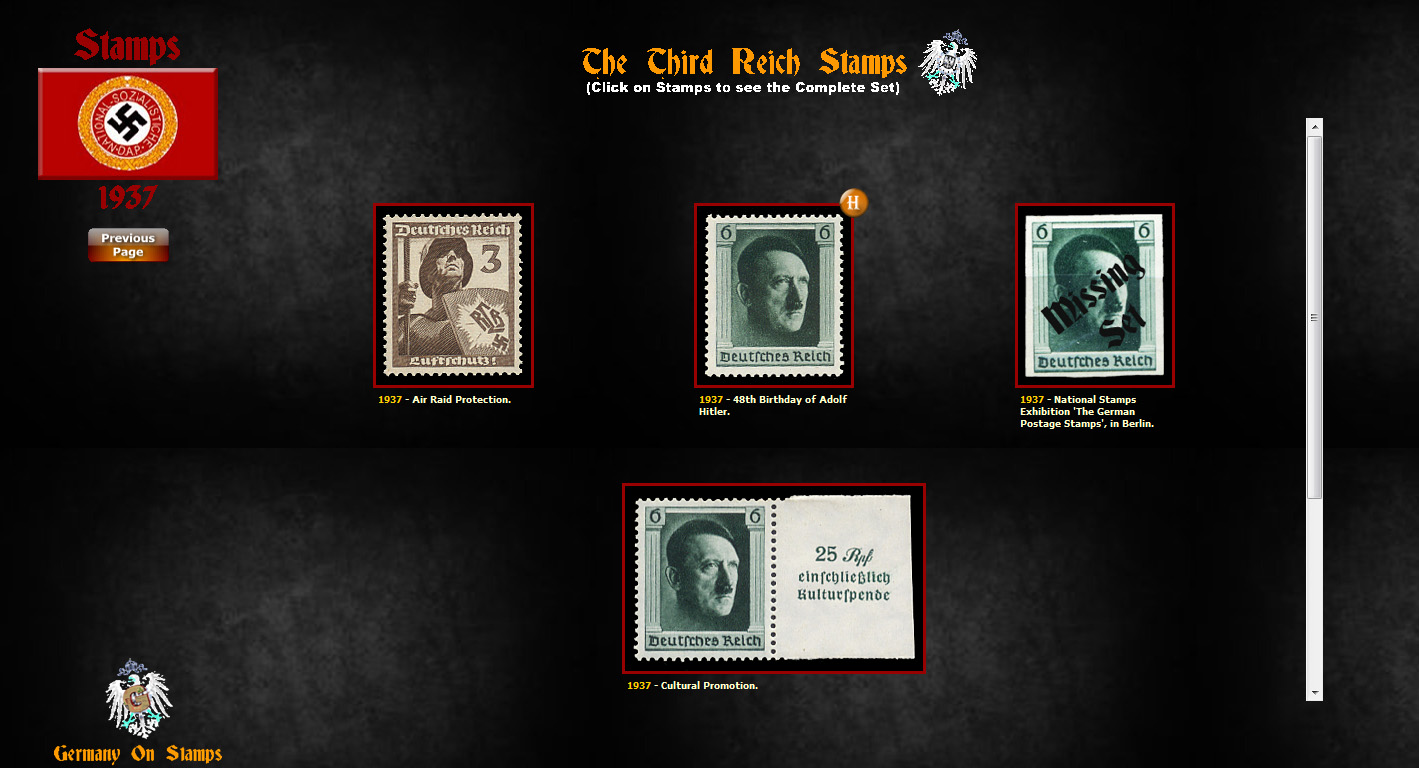

 After the First Reich (or Holy Roman Empire), from 962 to 1806, and the Second Reich, from 1871 to 1918, and mainly because the humiliation which led to the fall of Emperor Wilhelm II at the end of World War I and all the impositions that the German nation had to accept unconditionally, Adolf Hitler nurtured the dream of a Third Reich, which ends up imposing in 1933, after the rise to power of his National Socialist Party, which won the electoral supremacy during the political disorder that followed the economic crisis of 1929-1930, which creates instability and favour the emergence of extremism.
 Founded in 1919, in the aftermath of the humiliating Treaty of Versailles of that year - by which Germany is obliged to pay war damages to the Allies, to reduce its military and abandon the colonies -, the Nazi Party of Hitler, after the failed uprising 1923, decides to gain power through legal means. However, the relative prosperity and stability that Germany knows between 1924 and 1929 gives poor results for the Nazis elections.
 Anti-Semitism was another facet of this policy, by which Germany intended to "cleanse" the country. Thus, Hitler, in 1933, orders the expulsion of Jews from government positions. The persecution that moves them unreal outlines affects from 1935, with the abolition of citizenship rights and the flight of nearly 500 000 Jews from the country (where circulating properly identified by a yellow Star of David).
 In March 1938, the Germans occupied Austria, attaching it to the Reich (Anschluss). That same year, they were able to occupy the Czech region, most of Germany, the Sudetenland, with the consent of England and France (Munich Agreements). What remained of Czechoslovakia is dismembered in the next year, with the German protectorate of Bohemia-Moravia tax.
 On the first day of next month, however, the Germans forced the Polish border and march on Danzig, whose "corridor" wanted to join the conquering East Prussia, which triggers the Second World War (whose history is inseparable from the Hitler regime). The Third Reich was defeated and completely destroyed in the conflict, despite dominating scathingly until 1941 (Blitzkrieg).
 Declaring war on several European powers, in turn, and then to USA, suffer tremendous setbacks on the Russian front: Nazi Germany is losing military strength (particularly with the Allied bombings of the country from 1943), being harassed for their borders and ending to surrender unconditionally in 1945, but after losing former territories and redefining its borders (Yalta and Potsdam agreements).

 Johann Sebastian Bach born in Eisenach, Saxe-Eisenach, was a German composer,
organist, harpsichordist, violist, and violinist whose sacred and secular works
for choir, orchestra, and solo instruments drew together the strands of the
Baroque period and brought it to its ultimate maturity.
Johann Sebastian Bach born in Eisenach, Saxe-Eisenach, was a German composer,
organist, harpsichordist, violist, and violinist whose sacred and secular works
for choir, orchestra, and solo instruments drew together the strands of the
Baroque period and brought it to its ultimate maturity. In Weimar, he had the opportunity to play and compose for the organ, and to
perform a varied repertoire of concert music with the duke's ensemble. A master
of contrapuntal technique, Bach's steady output of fugues (is a contrapuntal
composition in two or more voices, built on a subject or theme that is
introduced at the beginning and recurs frequently in the course of the
composition) began in Weimar. The largest single body of his fugal writing is
"Das wohltemperierte Clavier" (The well-tempered keyboard).
In Weimar, he had the opportunity to play and compose for the organ, and to
perform a varied repertoire of concert music with the duke's ensemble. A master
of contrapuntal technique, Bach's steady output of fugues (is a contrapuntal
composition in two or more voices, built on a subject or theme that is
introduced at the beginning and recurs frequently in the course of the
composition) began in Weimar. The largest single body of his fugal writing is
"Das wohltemperierte Clavier" (The well-tempered keyboard).
 Apart from his brief tenures in Arnstadt and Mühlhausen, this was Bach's
first government position in a career that had mainly involved service to the
aristocracy. This final post, which he held for 27 years until his death,
brought him into contact with the political machinations of his employer, the
Leipzig Council.
Apart from his brief tenures in Arnstadt and Mühlhausen, this was Bach's
first government position in a career that had mainly involved service to the
aristocracy. This final post, which he held for 27 years until his death,
brought him into contact with the political machinations of his employer, the
Leipzig Council.


